

Air Leakage Testing
(Blower Door Testing)
A blower door test is an essential step in verifying a building’s air tightness and ensuring it meets today’s energy code requirements. Excess air leakage can lead to higher energy costs, comfort issues, and failed inspections—making accurate testing critical for builders, contractors, and homeowners alike. By identifying and measuring uncontrolled air movement, a blower door test helps you deliver a more efficient, durable, and code-compliant structure.
How A Blower Door Test Works
What Is Air Leakage Testing?
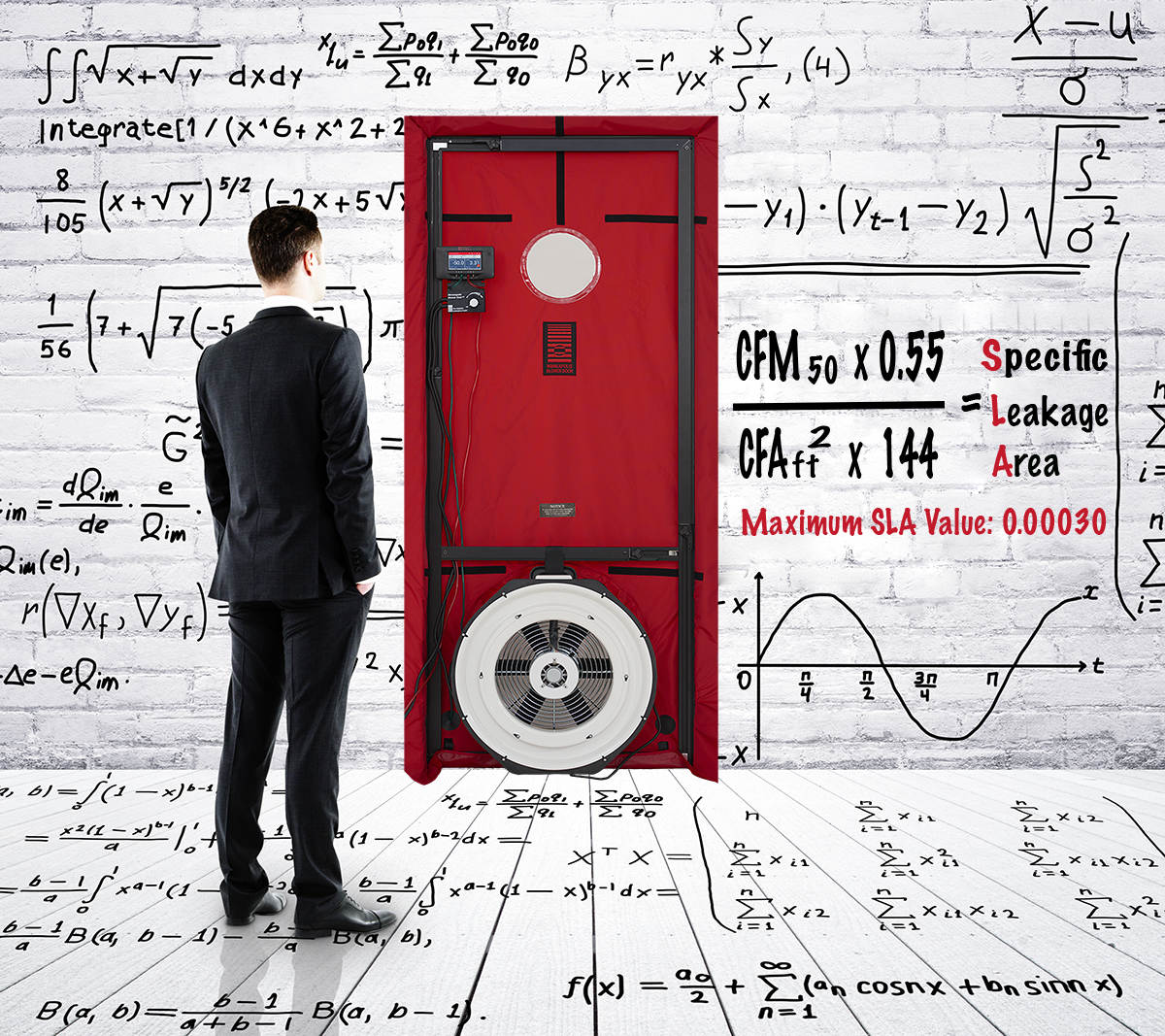
To perform the test, the home is first prepared by closing all exterior windows and doors, opening interior doors, and turning off HVAC systems and exhaust equipment. This creates a controlled environment that isolates unintended air leakage. A calibrated blower door system is then installed in an exterior doorway, and a digital manometer is used to precisely measure pressure and airflow.
While the home is under pressure, our technicians can also identify specific leakage points using advanced diagnostic tools such as smoke pens and infrared imaging. This allows builders to address issues before final inspection, avoiding costly delays or rework.
The home is depressurized to 50 Pascals—simulating real-world wind pressures—allowing us to accurately measure the amount of air leaking through the building envelope. This measurement, known as CFM50, is used to calculate Air Changes per Hour (ACH50), the standard metric required for energy code compliance in many jurisdictions.

With fast, reliable testing and clear reporting, blower door testing not only ensures compliance with local energy codes (such as IECC requirements), but also helps builders deliver higher-performing homes that stand out in today’s market.
Who Needs This Test?
Air leakage testing is typically required for:
New residential construction
Additions and major remodels
Projects requiring energy code compliance
Builders preparing for final inspection

Washington Energy Code Requirements
The Washington State University (WSU) Energy Program helps ensure that homes and buildings in Washington meet the state’s energy efficiency standards. These standards are defined by the Washington State Energy Code (WSEC), which establishes minimum requirements for building performance, including insulation, air sealing, and overall energy use.
As part of these requirements, the Washington State Energy Code mandates air leakage testing for most new construction and qualifying remodels. This testing verifies that a building meets minimum airtightness standards, helping to ensure energy efficiency, comfort, and long-term performance.

Air leakage testing, commonly known as a blower door test, measures how much air enters and escapes a building. Using specialized equipment, we create a controlled pressure difference to quantify air leakage and identify areas where the building is losing conditioned air. This test provides a clear understanding of how airtight a home or building is, offering insight into energy performance, comfort, and the effectiveness of the building envelope.
For homeowners, air leakage testing helps ensure that your home is built to modern energy efficiency standards. A properly sealed home is more comfortable, with fewer drafts and more consistent temperatures throughout.
It also helps reduce energy costs by preventing conditioned air from escaping and outside air from entering. In addition, controlling air leakage helps limit moisture movement within the building, which can reduce the risk of condensation and long term damage. In simple terms, this testing helps confirm that your home is not only built to code, but built to perform well for years to come.
What This Means for Homeowners
Understanding how an air leakage test works (and how it is scored) can make it easier to navigate Washington State Energy Code requirements and stay on track to meet the targets outlined in your Prescriptive Energy Code Compliance worksheet. The energy code uses a credit system, where points can be earned through various energy efficiency measures such as improved air tightness, additional insulation, or high-efficiency systems, all of which contribute to overall building performance and compliance. Achieving these targeted credits is an important step toward final approval and obtaining an occupancy certificate for your home or building.
Whatever you're building, we're here to help you take the first step with confidence.
How To Score Higher On Air Leakage Tests
Preparation for an air leakage (blower door) test should begin early in the construction process, well before insulation and drywall are installed. In fact, some of the most critical air sealing opportunities occur before the walls are even erected. For example, applying roofing tar or installing a sill gasket between the subfloor and the bottom plates of exterior walls is far more effective than relying on standard air sealing methods, such as caulking after the walls are built. Once framing is complete, attempting to seal the bottom plate from the interior is often less effective and can result in missed air leakage pathways that negatively impact overall building performance.
Once framing is complete, every penetration, (especially those created for plumbing and electrical that connect to the attic or crawlspace) must be carefully sealed, as these are some of the most common and costly sources of air leakage. If left unaddressed, these gaps can significantly impact blower door test results and lead to failed inspections. In addition, all drywall penetrations, (especially electrical boxes, plumbing rough-ins, and other openings) can allow uncontrolled air to enter the home if they are not properly sealed prior to drywall installation.
Another common source of air intrusion is at the top plate. It is very common for air to travel between the gypsum board and the top plate, allowing attic air to enter the living space. Drywall mud does not create an air seal. To effectively separate the attic from conditioned areas, this joint must be properly sealed before drywall installation. One of the most effective and straightforward methods is to install a sill gasket in an “L” shape along the top plate at the perimeter of all rooms, (not just exterior walls). The gasket should be applied so that part of it sits on the top plate while the other portion overlaps onto the ceiling framing or truss, where the drywall will be attached. This creates a continuous edge seal at the intersection of the wall and ceiling, preventing air from bypassing the drywall where the wall meets the ceiling. When installed correctly prior to gypsum board installation, this method significantly reduces air leakage at one of the most common and overlooked problem areas.
There are several simple techniques that can be applied during construction that will significantly improve your air leakage test results. All of these measures must be completed prior to gypsum board installation, as waiting until the home is finished often results in missed opportunities, lower blower door test scores, and potential code compliance issues. Once drywall is installed, many critical air leakage pathways become inaccessible and far more difficult to properly seal. For builders aiming to meet stricter performance standards—such as achieving 2.0 ACH50 or better—air leakage preparation should be planned well in advance, ideally before framing even begins, to ensure the highest level of air tightness and avoid costly corrections later in the construction process.
With Washington State adopting a Home Energy Score requirement that will soon be in effect—requiring homes to be evaluated before being sold—proper air sealing has never been more important. Northwest Infrared LLC is a building science company dedicated to helping you meet your performance targets, pass inspections, and achieve the energy scores your projects demand.
OR
FAQs
What services do you offer?
1
At Northwest Infrared LLC, we provide comprehensive blower door testing services designed to help builders, contractors, and homeowners achieve code compliance and improve overall building performance. Our services include blower door testing to measure CFM50 and ACH50, as well as pre-drywall air leakage consultations to identify critical sealing opportunities early in the construction process. Our consultants will ensure your project meets Washington State energy requirements. Our team also provides post-construction verification testing, detailed reporting for inspections, and practical guidance to help you reach your target, whether you’re aiming for standard compliance or higher-performance goals. In addition, we assist with Home Energy Score preparation, helping position your home for upcoming requirements. From initial consultation to final testing, we work closely with your team to keep projects on track and deliver reliable, results-driven solutions.
How do I get started?
2
Getting started with Northwest Infrared LLC is simple. The earlier you involve us in your project, the better your results will be. We recommend reaching out during the planning or early framing stages so we can provide guidance on air sealing strategies that will help you meet your target blower door score and avoid costly corrections later.
From there, we’ll coordinate scheduling for your blower door test at the appropriate stage of construction and ensure everything is set up for a smooth, successful inspection. Whether you’re a builder aiming for code compliance or higher performance standards, or a homeowner looking to improve efficiency, we provide clear communication, fast turnaround times, and actionable insights every step of the way.
Contact Northwest Infrared LLC today to schedule your project. We’re here to help you build tighter, more efficient homes and achieve your desired results with confidence.
What makes you different?
3
At Northwest Infrared LLC, we go beyond simply running a blower door test, we help you understand why your building performs the way it does and how to improve it. Our background in building science allows us to identify the root causes of air leakage, not just report the numbers. We work closely with builders, contractors, and homeowners to provide practical, cost-effective solutions that help you pass inspections, meet code requirements, and achieve higher energy performance scores. With fast scheduling, clear reporting, and a focus on real-world results, we make the testing process straightforward and valuable—not just another box to check. When performance matters, you need more than a test—you need a partner who helps you get it right the first time.
How can I contact you?
4
You can reach us anytime via text message or calling (360) 786-6850
Or you can send an email to David@northwestinfrared.com
Service Area
Mason County
Seattle
Tacoma
Lewis County
Snohomish County
Olympia
Chehalis
Bremerton
Kitsap County
Grays Harbor County